
OMNITRADE Operations

Traditional Maltese Luzzu

Artistic and symbolic elements of the Maltese luzzu

Almost in the centre of the Mediterranean Sea, the Maltese islands provide harbours for various types of traditional fishing boats.  One of these types, is the Maltese luzzu.  Decorated with different colours and symbols, the once prominent luzzu is today found in only a few harbours around the Maltese islands.


This short information aims to present and understand the meaning of colours and symbols of the luzzijet (singular luzzu), a type of traditional fishing boat found in the archipelago of Malta (fig. 1).  It probably evolved from the gozzo, an Italian boat that was regularly seen off the Maltese coast around the 19th century. The luzzu, usually between 9 ft and 25 ft (2.7 m and 7.6 m) in length, superseded other traditional Maltese boats due to its strong construction.  It is a double-ended, carvel-built open boat with a stern rudder, a false keel and extra planking at the bilge for extra framework support and protection while beaching.  Originally, it was propelled by oars, later developments added sails (spritsail and jib) and nowadays engines power the boats.


The luzzijet can be easily found afloat in Mgarr, Gozo’s main port, few in Msida and St Julian’s, St Paul’s Bay and Qawra, and more anchored in Marsaskala and Marsaxlokk, especially Marsaxlokk.
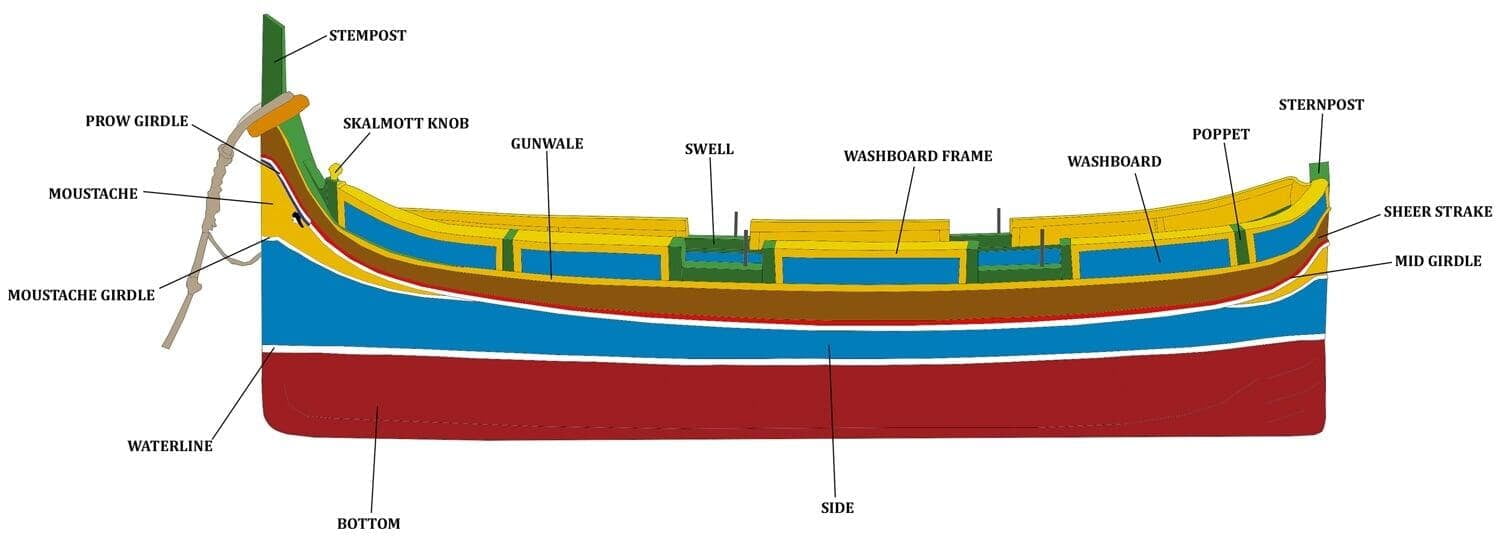
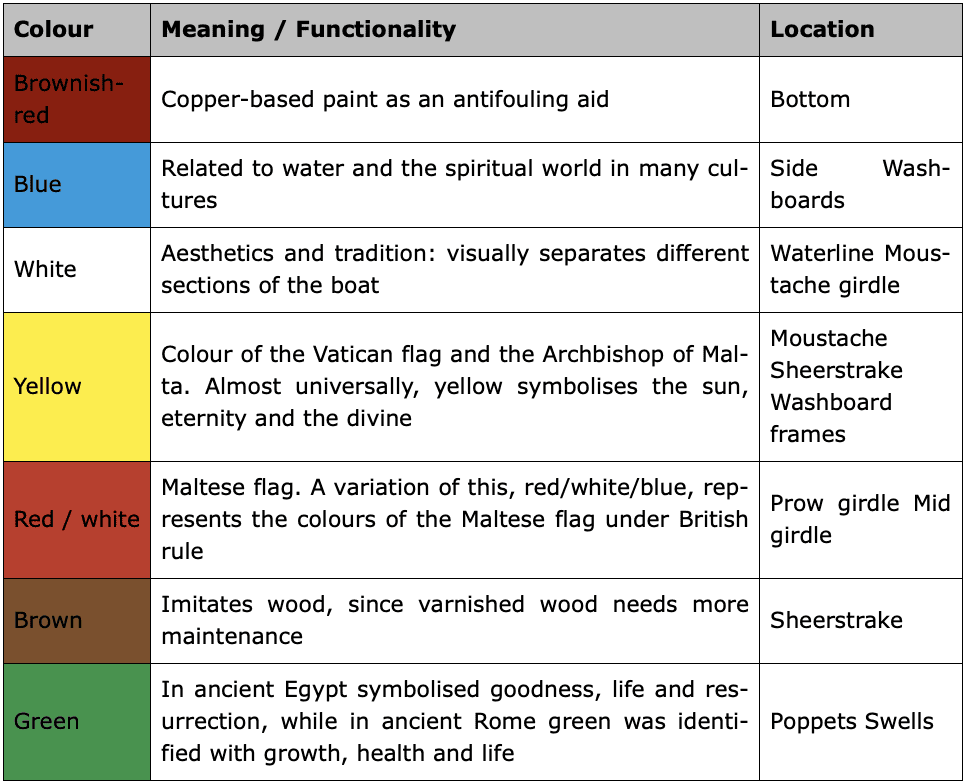
Fig. 1: Drawing showing the shape of a luzzu along with the terminology for each part

When choosing a colour, many factors come into play, including the practical, aesthetic, symbolic and cultural. The importance of the moustache (mustaċċ) to distinguish the location of origin of a luzzu, would mean that the boat came from St Paul’s Bay. A lemon yellow mustaċċ indicates it came from Msida or St Julian’s, whilst an ochre yellow would identify the boat as pertaining to the south (Marsaxlokk and Marsascala area)”. Sometimes the change to a black or dark blue moustache as a sign of grief when a relative dies.
Table 1: The table shows the dominant colour for each part of a luzzu

The bird, represented on the sides of the boat flying under the oculi usually carrying a scroll in its beak, can be identified as a debased form of the Christian dove carrying an olive branch. In Christianity, the dove symbolises the soul and is the image of the Holy Spirit. It can also be understood as a symbol of hope, since it helped Noah find land after the flood. Thus, it could act as a protective image, helping boats return home safely. In addition, recorded as an interesting tradition: during the launch and baptism of a luzzu, references to Noah’s tale can be found in the priest’s sermon, and also in the olive branch and cross that are attached to the stempost.

Oculi

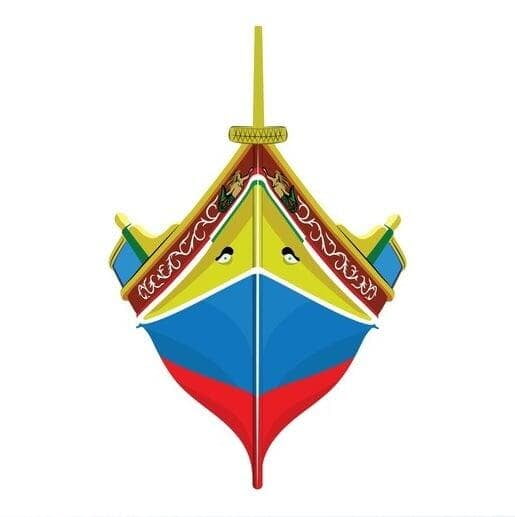
Oculi are depicted on the moustache. This symbol is present on many boats around the world, possibly indicating several inception points. It is not until the Egyptian civilization that this symbol becomes common. The eye appears as an independent entity or associated with a deity such as Ra, Atum or Horus. The eye of Horus was a popular amulet in ancient Egypt for protection against disease and the “evil eye”.  It can be seen on Ra’s sacred barque, on the bow of funerary ships and other objects ensuring a safe trip to the ‘other shore’'.  It is likely that the Phoenicians helped spread this symbol across the Mediterranean, with the Greeks and later the Romans continuing the tradition. Painted eyes also appear on pre-Islamic Arabic ships as protection against the ‘evil eye’ and the temptations of demons, a custom that probably spread to the East through trading routes.

In the early 1920s, locals thought the eye of Horus acted as a protection against the ‘evil eye’, while Gozo residents believed that the symbol gave a spiritual identity to the boats, as if they were ‘animated’. They were also associated with the success of the luzzu.  Similar symbolism is common today, but most eyebrows are painted black, or yellow as the second most common colour. Red and blue are rarer, while there was also one example of an orange eyebrow.  All these variations seem to be associated with personal preferences.

Bird/Dragon

When the sheer strake of the luzzu is decorated, the motif has been observed to be a garland of plants and flowers. In some luzzijet, this decoration is carved and painted yellow or white, although this only occurs on those boats where the sheer strake is varnished wood. Sometimes a dragon appears on the bow, or else a bird or a creature that is a mix of both. The bird, like the one on the side of the boat, can be interpreted as a dove holding a floral garland instead of the usual olive branch. When the bow figure has a more dragon-like shape, the rest of the pattern on the sheer strake can be interpreted as fire coming out of its mouth. In many Western societies, the dragon has a negative connotation related to evil. Thus, this symbol can be considered a memory of an older religion or culture.